CongaDr+ Tony's Conga Adventures: conga skins
Showing posts with label conga skins. Show all posts

Wednesday, May 28, 2008

Selling conga skins, making friends

One of the really fun parts of this business is meeting some of the coolest people around. - interesting, cultural, artistic people.

I sell top quality Cow hide. Some of the best skins around - i ship them to pro players all around the world.


James had some Mombiza solid shell drums that needed special skins to deal with the ringing, and a set of old Valje SF, in mint condition that needed skins as well. He dropped by to skin up one of his drums and talk congas.

He brought some of his drums, and gave me a blind test of Valjes, SF and LA. I closed my eyes and played both, without him telling me what i was playing.

It was more difficult than i thought, but was able to guess the LA valje. But the SF valje, with a much more woody tone, threw me. It almost sounded like a mahogany drum, with light airy overtones. These SF valjes are thinner and sound different than the LA drums, for sure. I like them both, actually.


Mike is skinning a set of Gon Bops congas, one at a time, and was by to pick up a tumba skin, as well as to show off the sound of the quinto skin i scored for him.

That's a nice sounding Gon Bops quinto, Mahogany, gell coated. They have a bit more projection, with the gel coat, and dont crack much at all, compared to other Mahogany Gon Bops of that era.

Its always fun to do business with people you like.

Email me, if you need high end skins for your congas or sets of bongo - congadr@gmail dot com

Tony

Friday, May 16, 2008

Conga skins - Mule, Cow, what's best?

If you are looking for high end Conga skins for the professional player, you have come to the right place.


The best way to get the best sound, is to have a player select your skin for you, your drum, and your gigging life.

Each drum, played by a specific player,playing a specific style of music demands a specific skin.

Most players prefer Cow. Getting the right piece, even if expertly tanned, is all in the selection.

After 30 years of playing, and 10 years of restoring congas and bongo, having played nearly every make of drums, in many different materials, I can hear the sound of a drum before it is skinned.

Knowing how people play - their chops, knowing the various styles of music and the application of the instrument in that setting. And knowing the cat with a huge stock of skins to sort through - as opposed to selling what ever shows up in the mail... I can hook you up with the right skin.

I provide skins for many top players across the country, including Pedrito Martinez, Sandy Perez, Ramon Diaz, Chris 'Flaco' Walker, to name a few. 

Here is an example of the Skins I sell, and some of the restoration work as well. 

Tony

congadr@gmail.com

Friday, May 9, 2008

Conga skins - Kip skin, steer skins, Cow hide

Thanks Korman,

Thin is different for each.. dont have a metric ruler with me, but...

Mule - thin can be as thin as thick buisiness card stock, to as thick as standard card board (two ply with zigzag inside)
Steer - thin is like the thickness of a quarter, thick is like standard card board
Cow - thin is like a dime, 1-2 mm thicker than two quarters
Calf is like a dime, fairly regularly
Kip is from a dime to a nickle
Horse is as thin as regular business card stock, and as thick as a dime.
Buffalo is from a dime to a nickle, but the only ones i have expereince with are the ones i take off of LP's when reskinning them. The animal may provide much thicker stock, but i havent purchased entire hides of this animal.

I dont know of any player who uses Mule for his Hembra, but Im sure you can get it to sound nice, with the right thickness. many people use Mule for the macho. Its a bit damp for use on the hembra, for me. I like a bit more punch out of my hembra tones. Buffalo makes great Hembra skins, actually. Its usually just the right thickness.

This is just my experience, and the products i have access to. Im sure it varies depending on the supplier.

There are many types of Cattle, many differing varieties, and im sure the hides vary in thickness depending on the species.

One other thing that may need metioning -

sound irrespective of the drum:

Cow - Medium bright slaps, round full open tones with medium sustain
Mule - bright, crisp slaps, slightly muddy open tones with short sustain
Buffalo - Bright slaps, ringy open tones with long sustain
Kip and Calf - bright slaps, trashy open tones, medium sustain (think gon bops stock skins)
Steer - mid-range slaps, round open tones with short sustain

Hope that helps,

Tony

Thursday, May 8, 2008

Conga skins - discussion

If you are looking for high end skins that are selected by a professional player, email me at congadr@gmail.com

conga skins for percussionsts and players of congas and bongo

I have some of the nicest skins Ive seen, finished very clean. The tone and slaps I can get out of these skins, is really top notch. If you have played skins from Texas, for example, you will like these much better.

I supply skins to the top players in the business, like Sandy Perez, Perdrito Martinez, Roman Diaz and to professional percussionists across the country.

Getting the right skin depends of a few key factors:

1 - The material, make, and quality of the drum being skinned - often dictates what type of animal hide we will use.

2 - The style of music being played and the region where you are gigging - Timba with a big band, rumba, Latin jazz, rock and roll, drum circle hits.. region also matters.. East coast likes a bit more lively sound, for instance, dry southwest and humid south... Getting the thickness right for each situation is the key.

 Drum skins for bongos and conga

3 - The performance situation - outdoors/indoors, humidity issues, with or without amplification, playing acousticly with amplified musicians, etc... the need for projection, ease of playing for heavy gigging, long gigs or religious work, etc..

4 - The experience of the player - how solid the chops are of the player also factors into the thickness and type of skin, as comfort and ability to easily make the primary tones and slaps, and the need for projection must be considered in the selection. 

conga skins for profesional percussionist - congadr@gmail.com

Email me at congadr@gmail.com and we can talk about the right skin for you. 

In response to a question about conga skins...

As far as Natural thickness from thin to thick,

--Calf (very young cow)
--Kip (young cow)
--Asian water buffalo
--Cow
--Steer/Bull
--Mule (offspring of male donkey and female horse)

That being said, there is a wide range in thickness of Mule, for example. and the supply of Mule is not plentiful. it is very difficult to get the right Mule skins and I have heard many a player complain about getting the wrong thickness, or having heavy flaws. If you get the right piece, Mule rocks for some specific uses.

Cow is much more available and the quality of product is much better. just much easier to find and thus easier to get a high quality piece.

Steer is not as varied in thickness as Cow. Kip and Calf are fairly uniform in thickness. Some Steer/Bull and some Mule is way too thick to use on a drum played with the hands. But some Steer is plained to a reasonable thickness for congas and sounds fine.

I think this discussion might be boiled down to this:

What skin is good for what drum?

What the pro's play in the bay area, in general

for salsa:

Oak quinto: medium to thick Mule, Steer or Cow
Oak conga: medium Cow
Oak Tumba: medium Cow

Mahogany quinto: medium Cow
Mahogany conga: medium Cow
Mahogany Tumba: medium Cow

Oak bongo: thin Mule or Horse, or kip on the Macho, med-thin Cow or medium Water Buff on the Hembra

Mahogany Bongo: thin Mule on the Macho, med-thin Cow, or medium water Buff on the Hembra

for Folkloric material - thicker in general:

Oak quinto: med-thick Mule Steer or Cow
Oak Conga: med-thick Mule or Cow
Oak Tumba: med-thick Cow

Mahogany quinto: medium Mule or Cow
Mahogany conga: medium Cow
Mahogany Tumba: medium Cow

Bata Cha's: med-thin Mule, or kip
Bata Iya's: medium Mule or Cow

Here is a post of a reskinning of a set of JCR Oak congas.. how to manage a ringy situation with the right skin - JCR Oak Conga Reskinning

conga skinning and hides, hide congadr@gmail.com


I sell Cow, Calf and Kip. But i use Mule for my rumba quinto ax and for my Macho on my Mahogany bongo. - depends on the drum and the player, however.

Again, that being said. People with chops that need work, and are not regular or long time players need thinner skins than most to the working percussionist. If you have the chops, a thicker skin sounds much better as it kills any over ring. But too thick of a skin can be hard on the hands, even with good technique, and can kill the tone of a conga.

Hope that helps,

Tony

Wednesday, April 30, 2008

How to skin a conga drum, by Tony Norris


A few people asked how to skin up a conga, so from now on, Ill send them here... so, welcome, you lover of the congas you. Welcome to a tutorial on how to skin a conga...

pic before and after the skin job....

Firstly, buy a top quality skin from me... then

Put a piece of tape on the crown where the handle, or bracket for the stand is, so you can mount it in the same place, in case your lugs are not evenly placed around the drum (ie, custom made)

Take the original skin off, and soak both the original and the new skin in a tub of water, completely submerged, overnight.

In the morning.. when you are ready to skin the drum, set out your tools, and get your workspace set up, with all the needed hardware on hand. Once the skin is out of the water, time is of the essence, as the more it dries, the harder it is to cut - leading to mistakes.

Tools needed - as many hand clamps as lugs, box cutter with new blade, vice grips or pliers, lug socket wrench, strong scissors, and a rubber mallet.


Firstly, prep the rim of the conga shell with some hard soap, or, in this case, a candle so the skin does not stick to the rim as it dries.


Take the old skin out of the water, and take out the metal hoop.

Make sure the drum, the crown, and the metal hoop are round.. measure with a tape.

If not, correct them - wood dowel inside the drum to fix a slightly out of round shell - keep it in place till the skin dries completely - Crown and metal hoop, bend them back to round, if need be.


Then, put the metal hoop inside the crown and see how it best lines up - the same overlap outside the crown, not in and outside the crown, so all parts of the metal hoop will not slip under the crown when tightened. find the best fit, mark the metal hoop with a pen where the tape is on the crown.


Then, put the soaked skin, smooth side up, on the drum, careful to center it.


Put the metal hoop on the skin, being careful to center it with even distance from the shell all around, and with the tape over the right area (over the handle or stand bracket, witchever you choose to mark the crown).


Then fold the skin over the metal hoop, being careful to keep the metal ring unmoved from its center spot on the drum.

Clamp the hand clamps over the folded skin over the metal hoop... one between each set of lugs.


Then, put the crown on, making sure the marking tape is over the handle or stand bracket.

Make sure all the skin is up and under the crown, and all the side plates line up with where the lugs catch the crown.


then, with your belly on one side of the crown, lean on the opposite side with both hands, getting the first lug in the side plate so you can get a couple of turns on the nut on the lug. You may need to do this without the washers, if you need the extra 1/8" to get the nut on.

Also, you may need to take the hand clamps off, if they are preventing you from getting the lugs on.

I like to use the clamps that are thin, for just this reason (big one pictured).


After you get the first lug on, with belly still holding the other side down, put both hands on the 'belly' side, making sure the crown stays over tucked skin as you take your belly off of the crown.

Now, pull, or push down on the crown opposite the first attached lug, and get a second, and third lug on.

The rest of the lugs should not be as difficult to get on.. so once you get all the lugs hooked up with a couple of turns of the nuts, make sure the crown is centered over the drum and the crown is in the right spot over the sideplates - correct with rubber mallet.
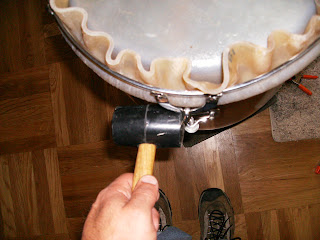

At this point, the we need to pull on the extra hide to make sure the metal ring seats, and locks the skin on the crown. So, pull on it with vise grips, or pliers, careful not to mark the part of the skin you are going to keep on the drum.

Squeeze the metal hoop to the crown as you pull the skin, make sure it seats, and get all the wrinkles out of the skin.


Then, tighten the lugs till the top of the crown is just under the rim of the drum - make sure the crown is level to the top of the drum, and is level in how it is tightened down... pull the extra skin down to make sure the crown is even all around the drum.

At this point, the skin should make a very deep and wet tone when lightly struck, then you know its seated and is locking the skin between the metal ring and the crown.

Depending on how you like it, the crown should be just under the top of the drum, at this point.


If you are sure it is seated, then you are ready to cut it.

Take a pair of very strong scissors and snip one fold of the extra skin, to get your razzor blade in to cut the rest of the extra skin off.

Once you cut a hole in it to get the blade in, let the blade rest on the crown, angled away from the drum so as not to cut the good part of the skin in this process.

Pull the extra skin away from the drum as you cut it with a very sharp and new razor blade being really careful not to cut the skin you want to keep on the drum. One slip can ruin a skin, and you will have to start over with a new skin if you slip, even if it is only slightly nicked, as they will split open over time. So, take your time with this final process.

So, almost done...

Dry the drum upside down, tightening the lug nuts by hand periodically. After the cut edge of the skin is dry and stiff, tighten the lug nuts a turn or two each. At this point you should hear a tone when tapping the skin, but be easy on it, it still can get marred. This method will prevent the skin from 'sagging' just inside of the rim as it dries. It will also prevent the white ring near the crown seen in this skinning. The wax you used to prep the crown comes in handy at this point, by letting the skin move over the rim as it dries.

Be careful to let the skin completely dry before tuning it up to a typical pitch. It may take a week in the winter.

Check out the lack of waste on this job!!! with a bit of trimming, i have some lashing i can use later.

fyi, this was an 18" skin put easily on a 11.25' conga.

Elapsed time: 15 minutes.


Well ,well, well.... that wasnt bad... now was it??? ;)


Tony